Tell us about the job
Takes about a minute. No obligation.
A heat pump here earns its failures the hard way. Homes in Hancock County, ME run heat about nine months a year, from September through May. The refrigerant circuit runs in heating mode through cold months when outdoor temperatures push the system toward the lower edge of its rated capacity, and the defrost cycle fires repeatedly to keep the outdoor coil clear. By the time a homeowner calls for a repair, the compressor and reversing valve have already logged a year with very little idle time. A contractor diagnosing a fault in this county checks those components first, because accumulated cycling wear is the likeliest source of what broke.
A heat pump sitting in a house this age was almost certainly not the original heating system. What a contractor finds once the unit is open depends less on the brand nameplate than on what generation of refrigerant circuit, control board, or reversing valve is inside it, and whether those parts are still in production. Half the homes in Hancock County, Maine were built in 1982 or earlier (2020-2024 ACS 5-year). That spread in the housing stock means plenty of systems out here have been retrofitted more than once, and each retrofit can leave behind components that do not share a parts lineage with anything currently warehoused. When the opened unit turns out to carry a discontinued component, the repair scope changes and the timeline does too.
The Parts of a Heat Pump a Contractor Checks During Repair
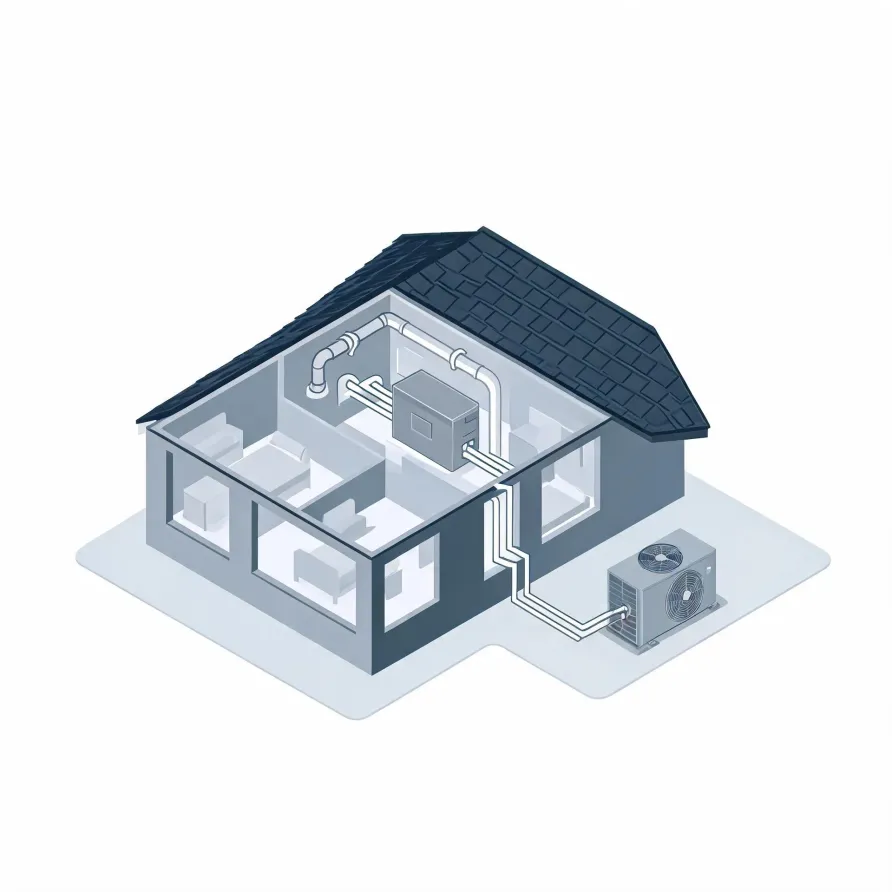
The outdoor unit is usually what a homeowner notices first, sitting on a pad beside the house. Inside it are the compressor and the condenser coil, both of which take the heat load of the whole system. When either fails, the system stops moving heat entirely. The air handler lives inside, typically in a utility closet or attic, and pushes conditioned air through the home. A contractor checks both units early, because faults at either end show up fast.
The refrigerant line set runs between the two units, carrying refrigerant in both directions. A leak anywhere along it starves the system and mimics other failures, so a contractor pressure-tests it as part of any diagnostic. The expansion valve, tucked inside the system where the refrigerant changes state, and the reversing valve, which is what lets a heat pump both heat and cool, are also common targets when the system behaves erratically.
The drawing alongside shows the general layout of these components, and a licensed contractor determines exactly what applies to the system in your house.
Find a contractor in Hancock CountyHancock County, by the record
155 severe weather events were recorded in Hancock County, Maine between 2015 and 2024.
NOAA National Centers for Environmental Information, Storm Events Database, bulk CSV export, events 2015-01-01 through 2024-12-31.Half the homes in Hancock County, Maine were built in 1982 or earlier (2020-2024 ACS 5-year).
U.S. Census Bureau, 2020-2024 American Community Survey 5-Year EstimatesHancock County, Maine holds 40,765 housing units (2020-2024 ACS 5-year).
U.S. Census Bureau, 2020-2024 American Community Survey 5-Year EstimatesOwners occupy 78.5% of the occupied homes in Hancock County, Maine (2020-2024 ACS 5-year).
U.S. Census Bureau, 2020-2024 American Community Survey 5-Year EstimatesRules & Standards Behind Heat Pump Repair in Hancock County, Maine1 sourced rules and standards
Licensing Rules for HVAC Repair in Hancock County, Maine
Maine licenses the fuel-burning side of heating rather than HVAC as a trade: a Maine Fuel Board licence is required to install or service solid fuel, oil, propane or natural gas burning equipment, including pellet-fired central heating appliances. Air conditioning is not named anywhere in the chapter.
Severe Weather Events in Hancock County, Year by Year
Heavy weather puts real strain on heat pump systems, cycling them harder and longer than ordinary conditions demand. How often that happens here shapes how much wear local equipment absorbs and how quickly repair needs show up.
155 severe weather events, 2015–2024. Source: NOAA National Centers for Environmental Information, Storm Events Database.